
Buddha-nature and Shin Buddhism
Posted: March 27, 2008 | Author: Doug | Filed under: Buddhism, Jodo Shinshu, Religion, Shingon, Zen | 5 Comments »Warning: Long post, but hopefully interesting. 
Jodo Shinshu, or “Shin”, Buddhism is unusual among Mahayana Buddhist sects in that it denies the notion of Buddha-nature in the conventional sense. Buddha-nature is a term that gets used a lot in Buddhism, and is used in positive terms to show that within a person is the potential to be a Buddha. In Soto Zen for example, you often hear that while you are meditating, you are a Buddha, you are expressing your Buddha-nature. A nice Shingon Buddhist priest in my neighborhood, upon hearing about Baby being born, wrote me a friendly email saying “Congratulations on the birth of a new Buddha”.
However, in discussing Buddha-nature, Shinran once wrote the following:
Karmic evil originally has no form;
It comes from delusions and inverted thinking;
The nature of Mind is originally pure,
but no one has a mind true and sincere.
The notion of “original mind” is another euphemism for Buddha-nature. The idea among Mahayana Buddhists (including Zen among others) is that when we purify our minds of ignorance, then Buddha-nature emerges from deep within our mind and we are enlightened. A typical analogy is a pond whose waters are disturbed. When the water settles, we can see our reflection.
But here, Shinran is saying that no one has Buddha-nature, by default that is.* People are, in Shin Buddhist terms, bonnō (煩悩) meaning ignorant and passionate by their nature. Oftentimes, people don’t even know they’re ignorant (or the extent of their ignorance). Shinran denies the notion of people possessing an original mind that only needs to emerge.
People reading this may find the notion offensive. Buddha-nature has a positive connotation to it, but Shinran is taking a decidedly negative view point instead. However, there is more.
Shinran writes about Buddha-nature in his text Notes on Essentials of Faith Alone:
The Tathagata pervades the countless worlds; it fills the hearts and minds of the ocean of all beings. Thus, plants, trees, and land all attain Buddhahood. Since it is with this heart and mind of all sentient beings that they entrust themselves to the Vow of Dharmakaya-as-compassion (Amida Buddha), this entrusting is none other than Buddha-nature (Notes, p. 42).
This is a pretty cryptic statement, and although I’ve read it many times, I just never got it. Recently I was re-reading Taitetsu Unno’s book River of Fire, River of Water, which helped shed light on this at last.
What he says here is that though we have no Buddha-nature by default, through entrusting ourselves to Amida Buddha, Buddha-nature now becomes a reality within us. Shin Buddhists who have followed for a long time, often describe how they thought they were “practicing” Buddhism, only to realize much later in hind-sight that it was Amida leading them. That awakened aspiration towards Enlightenment does not come from within ourselves, but rather from Amida Buddha.
This is confirmed by excerpts for example in the Nirvana Sutra:
Great joy and great even-mindedness are none other than Buddha-nature. Buddha-nature is Tathagata [Buddha].
And in the Flower Garland Sutra:
The Tathagata [Buddha] dispels forever
The doubts of all sentient beings,
And all the aspirations of their hearts
He brings to complete fulfillment.
I thought about this further, and came to a realization that the self (or rather the illusion of self) cannot be used to awaken from the illusion of self. In other words, there’s something fundamentally limited about the notion of an entirely self-oriented approach to Buddhism. As the saying goes “the eye cannot see itself”. It takes something external to reveal what the eye really is.
So, this is where the notion of entrusting one’s self to Amida Buddha becomes something very important.
Also, for all you scholars out there, the notion of Amida Buddha being not a physical Buddha, but the truth itself manifested as compassion (Dharmakaya-as-compassion above) is not unique to Jodo Shinshu. I had an interesting conversation with another Shingon priest recently who reminded me that in Shingon Buddhism, which is an older sect of Buddhism than Jodo Shinshu, also treats Amida Buddha as Dharmakaya-as-compassion. In Shingon Buddhism, the central Buddha is Mahavairocana, who is the embodiment of reality and truth itself, but Mahavairocana manifests in other forms as shown in the famous Matrix Mandala below:
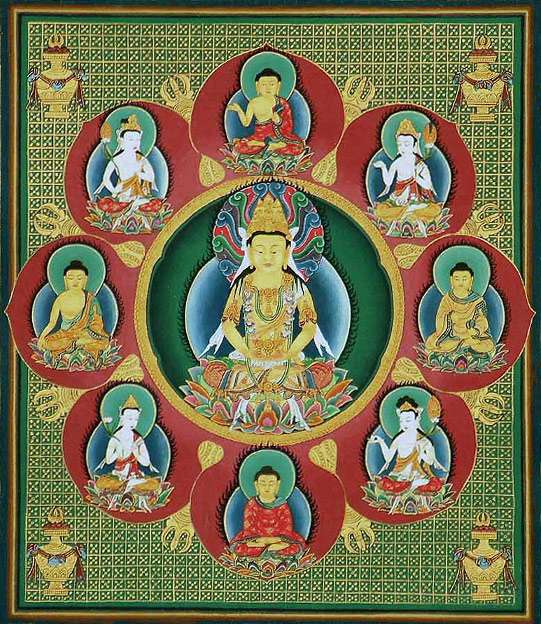
In this Mandala, Mahavairocana the primal Buddha, sits in the middle with various emanations around him. Amida Buddha sits at the bottom, in red robes (typical symbolism in esoteric Buddhism). The point here is that instead of reading the Buddhist sutras about Amida Buddha literally, the deeper meaning is that Amida Buddha embodies truth, but in the form of sincere and boundless compassion.
Entrusting one’s self to Amida is more than just entrusting to some savior figure, it’s something far deeper and more moving, but this does not reveal itself right away. You can’t force it either, it just happens on its own pace, in its own time.
I’ve said it before, and I’ll say it again: Jodo Shinshu starts out such a counter-intuitive teaching, but the more you explore it, the more profound and sensible it becomes. :p
Namuamidabu
* – In nerd/programmer terms, the person object has a $buddha_nature variable set to 0 by default. Or is that a 1? I always forget. 
 Hello, this blog is about my life as a father, Buddhist and Japanophile. Any useful information I can pass along will hopefully make the
It is hard, for a beginner like me, to concieve of Amida Buddha as anything at all, much less the Dharmakaya-as-compassion above. It is a very tricky thing to get a grasp on, though certain Buddhist brands would bust my chops for try to “grasp in the first place.
Believe me, I’ve been banging my head on it for 3 years with no real understanding until recently.
Then again, whether we actually understand it or not really isn’t critical. It’s more of a Gerald-Ford-obsession-thing again.
If you didn’t have the obsession thing driving you we couldn’t piss our time away reading your blog. Its sucks for you, but it works out nicely for us.
I’ll second that! But to add my piece… Shinran’s words are cryptic indeed, however, that sense of negativity breeds the question- Why believe in anything? I believe we ALL have the potential to be whatever we want to be. Negative thoughts or even realistic thoughts can slow or even halt progress all together. When you reflect on you buddha-nature all that exists is compassion. Your “spirit” cannot soar if youre anchored to emotional attachments. You feel ignorant, guilty, doubt only when you bring your intention there… you never feel it if you don’t. Beginners (in my opinion) should never arrive at the base of Buddhism and feel that the journey is outside of them (unattainable in other words).
Erg: Ha ha ha, thanks.
Michael: But you see, many people who convert to Shinshu started out in other Buddhist sects. I’ve known a number of Shin Buddhists who started out with Zen or Theravada, but realized they just couldn’t see it through, and came to Pure Land Buddhism instead. In Shin thought, one has to exhaust self-power first, before they can truly come to rely on Amida Buddha. People often miss that and either don’t try, or never delve into Shin Buddhism. There’s nothing wrong with the practices people do, but at some point they fall short. Zen teachers will tell you the same thing, as well Theravada Buddhists. At some point, you have to just let go.
I think also that Buddha-nature, frankly, gets overplayed in Western Buddhism. It becomes a kind of “I’m ok, you’re ok” term. Of course, I believe that all beings can be enlightened, but I also believe that the notion that you can make yourself Enlightened by following 5 easy steps is kind of backwards. That’s where I agree with Shinran that you can’t awaken your buddha-nature on your own.